A blocked polyurethane deck does not always need a different aperture. Near-size particles may peg individual openings, wet fines may coat the surface, or a poor feed pattern may overload one zone while the rest of the panel remains open. Effective screen blinding troubleshooting begins by classifying the blockage before changing media.
This guide gives aggregate, mining, and dewatering teams a field-based method for diagnosing screen blinding, separating feed, moisture, vibration, panel, and support causes, and running a controlled trial that preserves separation requirements.
Table of Contents
Classify Screen Blinding Before Cleaning the Deck
Photograph the deck by zone and mark feed, discharge, side, and center positions. Near-size pegging usually shows individual particles wedged in openings. Fine-particle screen blinding forms a layer across many apertures, while wet cohesive buildup may bridge panel joints and support areas. Localized blockage near the feed point indicates presentation or impact as well as aperture behavior.
Record whether blockage develops immediately, only with wet feed, or gradually through a shift. Note product size, recirculating load, moisture, clay content, temperature, and cleaning history. Do not clean away the evidence before those observations are captured.
Map Feed Distribution Across the Screen
Uneven feed depth changes the probability that particles reach an opening. A thick bed in the center can mask apertures, while lightly loaded edges show apparently good performance. Inspect the feed box, chute lip, impact zone, and side spillage. Correcting distribution may reduce screen blinding without changing panel size.
Compare blockage by row from feed to discharge. If the first modules blind while downstream panels stay open, impact, fines loading, or insufficient stratification may be involved. If blockage increases later, moisture migration or near-size concentration may be more important.
| Pattern | Likely driver | Controlled check |
|---|---|---|
| Individual wedged particles | Near-size pegging or particle shape | Measure blocked-particle size and orientation |
| Continuous fine coating | Moisture and cohesive fines | Compare wet and dry feed periods |
| Center lane blocked | Uneven feed distribution | Map bed depth across width |
| One module repeatedly blocks | Support, spray, or panel damage | Swap position after inspection |
| Blockage after shutdown | Drying or compacted residue | Review washdown and restart procedure |
Measure the Near-Size Fraction
A nominal top size does not show how much material sits close to the aperture. Sample the actual feed during the problem and determine the fraction near the opening size. Elongated or flaky particles can peg even when their nominal sieve size seems acceptable. Screen blinding decisions should use the real distribution, not a historical feed sheet.
Also sample the product and oversize streams. Changing aperture shape may improve release but alter cut performance or open area. Establish which separation result must be protected before testing a slotted, tapered, or differently oriented opening.
Check Vibration at the Deck, Not Only the Drive
Drive settings do not guarantee that every deck area receives the intended motion. Loose supports, cracked structure, worn mounts, panel gaps, or loading can change local amplitude. Measure according to the equipment procedure and compare sides and zones. Reduced movement can allow screen blinding to persist even with suitable media.
Inspect panel fastening and support contact after safe isolation. A panel that lifts, bows, or sits on debris may not flex as designed. Correct structural and fastening issues before attributing the condition to polyurethane hardness.
- Map blockage before removal.
- Record feed moisture and near-size distribution.
- Compare bed depth across the deck.
- Inspect support and fastening under isolation.
- Verify that any screen blinding trial maintains the required cut.
Review Water and Spray Placement
Water can disperse fines and keep openings clear, but poorly placed sprays may push material into apertures, create localized slurry, or leave dry bands. Check nozzle condition, pressure, angle, coverage, and whether water reaches the blockage zone. More water is not automatically a solution for screen blinding.
For dewatering, the process goal may require removing water rather than adding it. Review upstream dilution, drainage, and residence time. Document changes one at a time so the effect can be separated from feed variation.
Inspect Aperture Geometry and Panel Condition
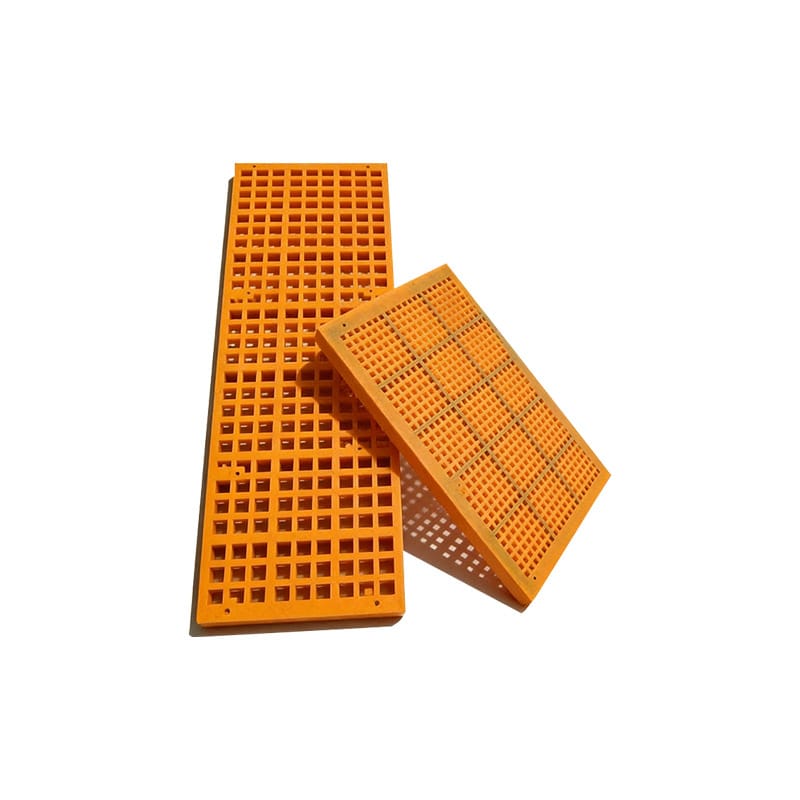
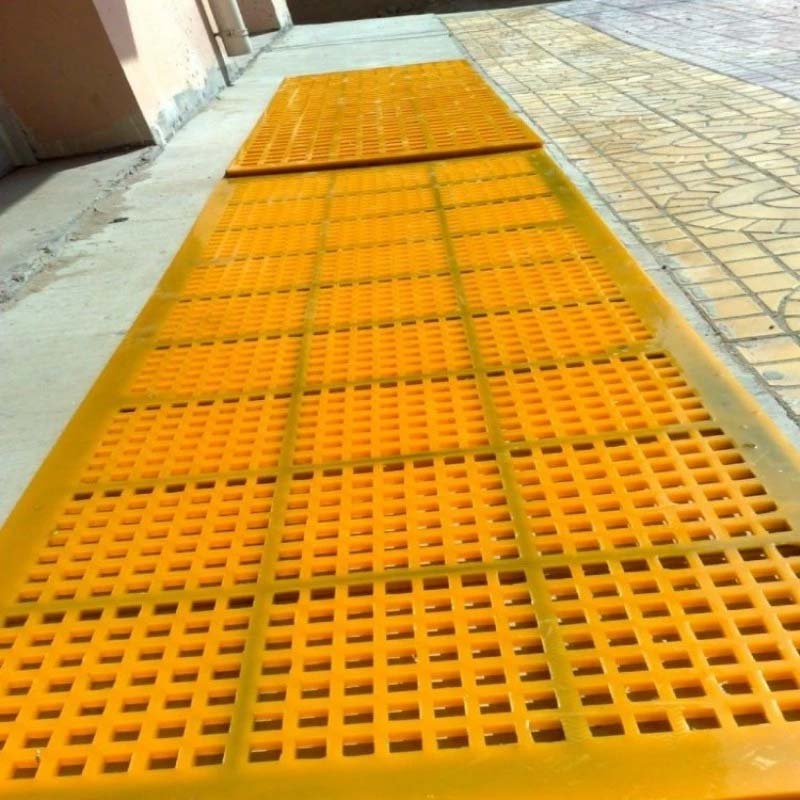
Measure representative openings and look for rounded edges, deformation, cuts, embedded particles, and closed taper. Wear can increase some dimensions while distorted lips reduce effective release. Compare new and used modules. The polyurethane screen panels page shows the modular polyurethane format relevant to screen blinding review.
ASTM D2240, ASTM D412, and ASTM D624 can support material control. Field opening geometry and deck behavior still need direct inspection.
Choose a Trial That Changes One Cause
A useful trial might redistribute feed, replace one damaged support, change aperture orientation in one documented zone, adjust an approved vibration setting, or revise spray coverage. Do not change panels, water, and operating settings simultaneously. The result would not identify what reduced screen blinding.
Define trial duration, feed window, throughput, product specification, open-area observation, and cleaning stops. Repeat under comparable conditions where practical. ASTM D5963 may support abrasion comparison, but field trials establish separation and blockage behavior.
Build a Deck-Zone Maintenance Record
Track panel location, installation date, feed zone, opening, wear, blockage type, cleaning method, and replacement reason. A zone history reveals whether screen blinding follows a particular module, support position, feed pattern, or seasonal moisture change.
The polyurethane screen panel guide and PU belt cleaner selection guide provide related screen selection and conveyor-maintenance context. Use those internal resources with the field map rather than treating every blocked opening as the same problem.
Cleaning method deserves its own control. Steel bars, high-pressure tools, or aggressive scraping can enlarge openings, cut flexible lips, and create a rough surface that blocks faster on the next run. Define approved tools and safe access, then record when manual cleaning is required by deck zone. If one zone needs repeated intervention, treat that frequency as diagnostic evidence rather than normal housekeeping.
Product sampling should accompany visual open-area checks. A deck can look cleaner after an aperture change while allowing misplaced oversize into the product, or it can preserve cut quality while sacrificing throughput. Track at least the metric that motivated the trial, the required product result, and the maintenance burden. That balanced record keeps a local improvement from creating an unnoticed downstream problem.
Frequently Asked Questions
What is the difference between screen blinding and pegging?
Pegging is usually individual near-size particles wedged in openings. Blinding more often describes fines or wet material covering many apertures, although field terminology varies.
Does a larger opening solve screen blinding?
It may release particles more easily, but it also changes separation. Classify the blockage and protect the required cut before changing opening size.
Can harder polyurethane reduce screen blinding?
Hardness affects panel response, wear, and release, but feed moisture, particle shape, vibration, support, and aperture geometry may dominate. Test the complete deck condition.
How should screen blinding be measured?
Use zone photographs, percentage of blocked openings or open area, cleaning stops, feed condition, throughput, and product results under a defined observation method.
What information should be sent for a panel review?
Provide deck layout, aperture, panel size, feed distribution, size analysis, moisture, vibration settings, sprays, blockage map, wear photographs, throughput, and product specification.
Request a Screen Blinding Application Review
Huadao can review polyurethane screen panels using deck-zone photographs, feed data, panel geometry, and operating conditions.
Share the blockage map through the contact page to investigate screen blinding without changing several variables at once.