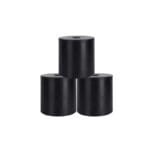
A soft mount is not automatically an effective isolator. If its loaded natural frequency sits near the machine’s excitation, motion can increase rather than decrease. A vibration isolator must support the actual load, provide the intended deflection, control movement in every direction, survive shock, and resist the surrounding environment.
This selection guide helps machine builders connect frequency behavior, load distribution, geometry, overload stops, bonding, and validation before specifying a vibration isolator.
Table of Contents
Measure Excitation Before Choosing a Vibration Isolator
Identify rotational orders, reciprocating events, impacts, and broadband sources across startup, normal speed, coast-down, and fault conditions. Record frequency and amplitude at the machine and supporting structure. A vibration isolator selected from outside dimensions alone cannot target the source.
Distinguish vibration isolation from shock cushioning and from static leveling. One component may serve several roles, but each needs a separate acceptance criterion.
Calculate Load at Each Mount
Total machine mass is not equally distributed when the center of gravity is offset or external forces act. Determine static and operating reactions at every support. The loaded deflection of each vibration isolator influences system frequency and machine level.
Include piping, hoses, guards, and cable connections that can bypass mounts or apply side load.
| Input | Why it matters | Verification |
|---|---|---|
| Load per mount | Sets loaded stiffness and deflection | Reaction calculation and installed height |
| Excitation frequency | Determines isolation region | Speed/order measurement |
| Motion limit | Prevents contact and misalignment | Clearance survey |
| Shock event | May require stops | Transient load case |
| Fluid and temperature | Affects compound | Exposure review |
Use Loaded Deflection, Not Hardness Alone
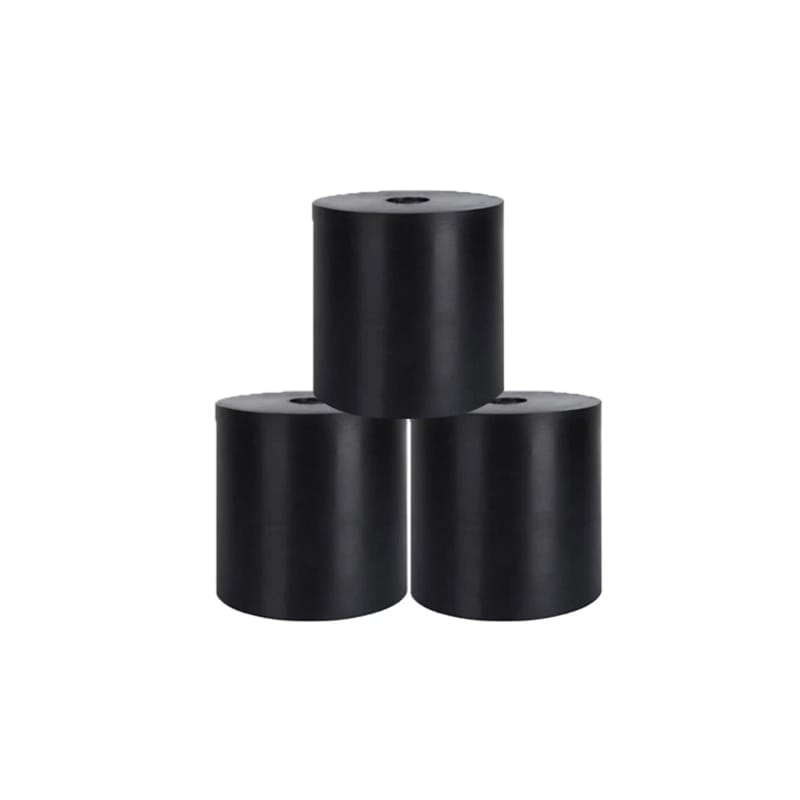
Hardness does not uniquely determine spring rate. Shape factor, loaded area, height, voids, shear geometry, and confinement change stiffness. Request a load-deflection curve for the proposed vibration isolator and identify the working point.
A softer compound in a confined short section may be stiffer than expected. Prototype the production geometry.
Keep the System Away From Resonance
Isolation improves when excitation is sufficiently above the supported system’s natural frequency. Near resonance, amplitude can rise. Startup and shutdown may pass through this region, so assess duration and available damping. Do not claim that a vibration isolator removes all vibration.
Consider rotational-speed changes, variable-frequency drives, and changing payload. A mount suitable at full speed may behave differently during a long ramp.
- Measure excitation and operating ranges.
- Calculate load at each vibration isolator.
- Check loaded height and available movement.
- Identify bypass paths from pipes and cables.
- Provide overload stops without contact in normal operation.
Control Motion in Compression and Shear
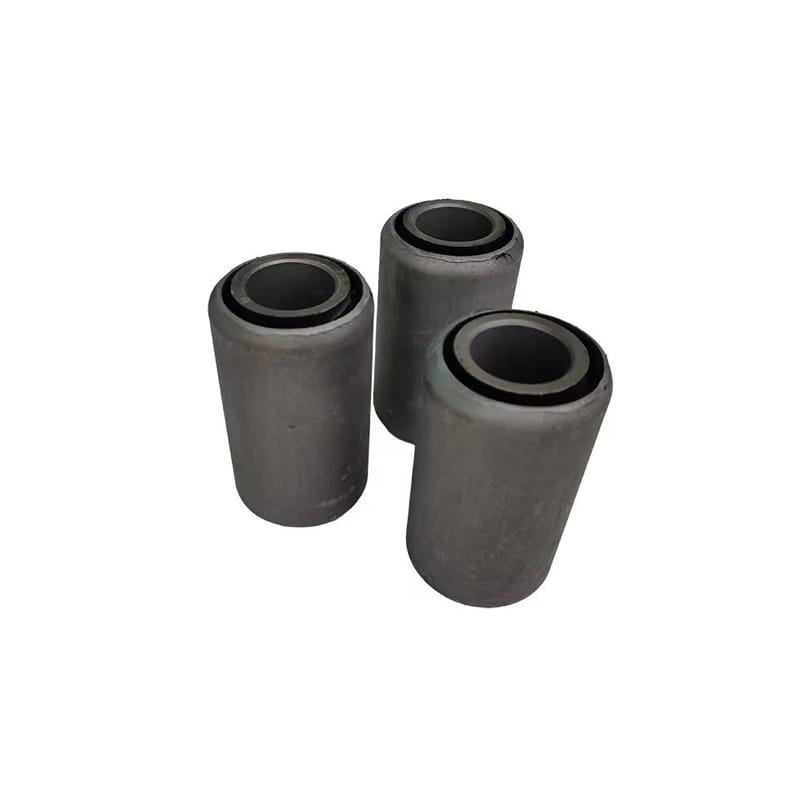
Mount orientation decides whether rubber works in compression, shear, or both. Shear can provide useful compliance but may require lateral guidance. Check fore-aft, lateral, vertical, and torsional movement. A vibration isolator should not allow the machine to strike guards, misalign couplings, or overload flexible connections.
Use stops or snubbers for credible shocks while maintaining clearance during normal motion.
Review Bonded Inserts and Fasteners
Metal-rubber interfaces carry cyclic load and can fail from peel, corrosion, or excessive preload. Define insert material, preparation, fastener torque, washer support, and bond-edge geometry. The rubber buffer spring guide provides related bonded-part guidance.
ASTM D429 can inform adhesion evidence, but the installed vibration isolator needs cyclic and overload validation.
Match the Compound to the Environment
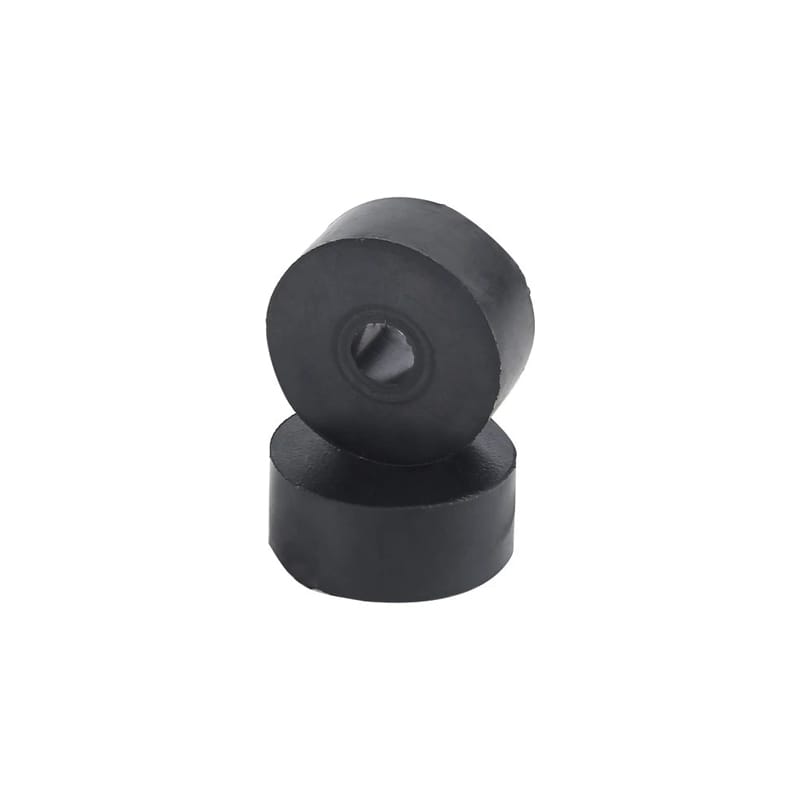
Oil, coolant, ozone, outdoor weather, heat, and cleaning agents can change stiffness and strength. Provide the full exposure sequence. ASTM D471, ASTM D573, and ASTM D2240 support compound comparison.
Recheck load-deflection after relevant aging when property change could shift vibration isolator behavior.
Validate Isolation and Machine Motion Together
Measure vibration upstream and downstream of the mounts at the frequencies of interest, while also recording machine displacement, level, coupling alignment, and stop clearance. Repeat startup, normal duty, shutdown, and shock cases.
The heavy-duty rubber buffer spring and rubber-to-metal bonding guide pages show custom isolator and spring options. Provide machine layout and measured data for a credible vibration isolator review.
Foundation flexibility belongs in the model. A mount on a thin frame rail does not behave as if attached to a rigid laboratory base. Local bending can change load distribution and introduce another resonant element. Check mounting-plate thickness, bolt support, grout, and foundation condition before attributing every measured peak to the elastomer.
Leveling must preserve load sharing. If one mount is adjusted high, it may carry excessive reaction while another is lightly loaded, shifting both natural frequency and available travel. Measure installed height or reaction according to the design procedure and repeat after piping and accessories are connected.
Maintenance should trend cracks, bond edges, loaded height, hardening or swelling, loose fasteners, stop clearance, and unusual machine motion. Replace based on functional change and documented condition. A surface check alone may miss compression loss or a rigid bypass that has developed elsewhere in the installation.
Isolation performance can change when the machine carries variable payload or consumables. Calculate or measure mount reactions for empty, normal, and maximum operating states. If the range is wide, one fixed-rate solution may place the system near resonance or outside motion limits in part of the cycle. Consider staged support, another geometry, or an operating restriction based on responsible dynamic analysis.
Commissioning records should include sensor locations and directions. A reading on a flexible guard cannot be compared with one on a bearing housing, and an overall RMS value can hide a narrow frequency peak. Save spectra, machine speed, load, and mount state so later maintenance can determine whether a change comes from the source, foundation, or support elements.
If measurements show a strong structural resonance, changing mounts may not be the only response. Source balancing, alignment, foundation reinforcement, operating-speed avoidance, or flexible-connection changes can be more effective. Record which corrective action targets the source and which targets transmission, then verify the combined result.
After installation, recheck coupling alignment and connected equipment at operating condition. Mount deflection can shift shafts or pipes from their cold rigid-support position, creating forces that bypass isolation and shorten component life.
Frequently Asked Questions
How is a vibration isolator selected?
Use load per mount, excitation spectrum, target isolation, motion limits, shock, geometry, environment, and loaded load-deflection behavior.
Does a softer vibration isolator work better?
Not automatically. Excess compliance can create resonance, large motion, instability, or contact. Geometry and loaded stiffness matter.
Why does vibration increase after adding mounts?
The supported system may be near resonance, mounts may be unevenly loaded, or rigid connections may bypass isolation.
Should a vibration isolator include a stop?
A stop can protect against overload or excessive motion, but it needs clearance so it does not transmit normal vibration.
What data should be sent for an isolator review?
Provide machine mass and center of gravity, support locations, excitation frequencies, speeds, load per mount, motion limits, shock, environment, and measured vibration.
Request a Vibration Isolator Application Review
Huadao can review heavy-duty rubber buffer spring using load, frequency, motion, geometry, bonding, and environment.
Share measured operating data through the contact page before selecting a vibration isolator by hardness or size alone.