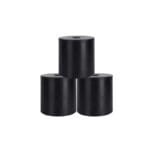
POM is frequently chosen for guides, valve parts, gears, and bushings because it machines cleanly and absorbs much less moisture than nylon. That reputation can become misleading when a design treats the polymer as dimensionally inert. POM stability still depends on temperature, load, wall balance, stock stress, machining sequence, chemical exposure, and the installed fit.
This guide explains how to preserve POM stability in precision machinery from material selection through final inspection. It focuses on the points where otherwise accurate components distort, creep, bind, or lose alignment.
Table of Contents
Define the Precision Window in Service
List the clearances, concentricity, flatness, or alignment that must remain functional at minimum and maximum temperature. Include continuous load, assembly preload, cleaning fluids, and dwell time. POM stability should be evaluated against the operating window rather than a single room-temperature inspection.
Separate reversible thermal movement from permanent creep or stress relief. A guide that grows while hot and returns after cooling needs expansion allowance; a bushing that remains deformed after long load needs a different geometry or stress level.
Compare POM Copolymer and Homopolymer Deliberately
The two main POM families can differ in mechanical, thermal, chemical, and center-line-porosity behavior. Do not allow a generic POM callout when the application depends on a particular balance. Request grade-specific data and traceability. The choice can influence POM stability, machining, and long-term performance.
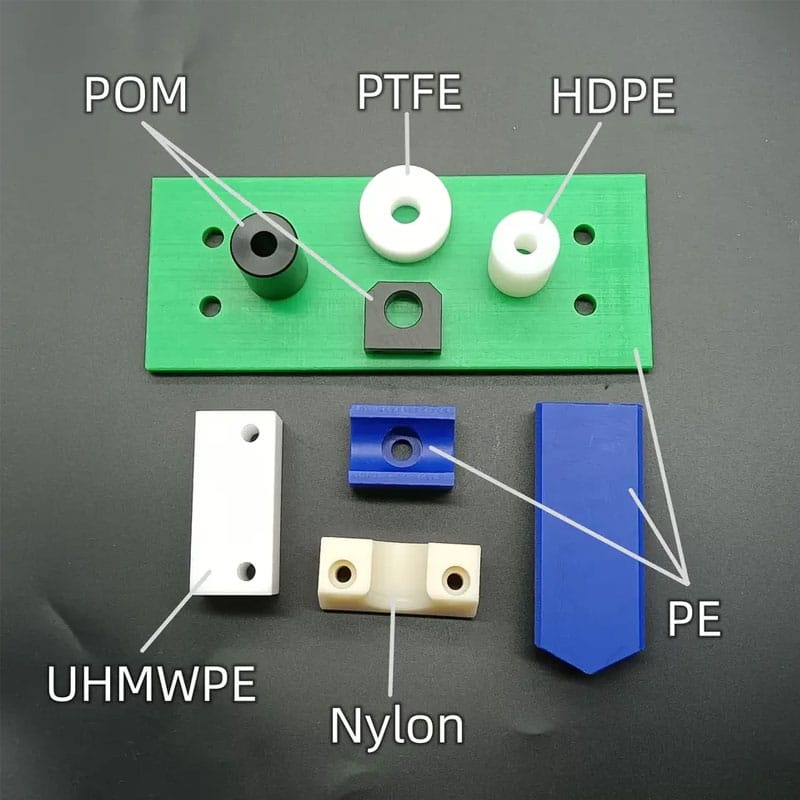
Compare alternatives using the actual environment. Nylon may offer toughness but greater moisture movement; UHMWPE may offer low friction but lower stiffness; another polymer may be required for chemistry or heat. The POM CNC turning guide provides a broader POM and nylon comparison.
| Design factor | Potential POM response | Practical control |
|---|---|---|
| Temperature rise | Thermal expansion changes clearance | Provide calculated operating allowance |
| Continuous stress | Creep alters fit or preload | Reduce stress and increase support |
| Heavy one-sided machining | Residual stress releases unevenly | Rough symmetrically and stabilize |
| Press fit | Hoop stress and time-dependent movement | Prototype installed dimensions |
| Aggressive chemical | Cracking or property loss | Test exact grade and exposure |
Balance Wall Sections and Material Removal
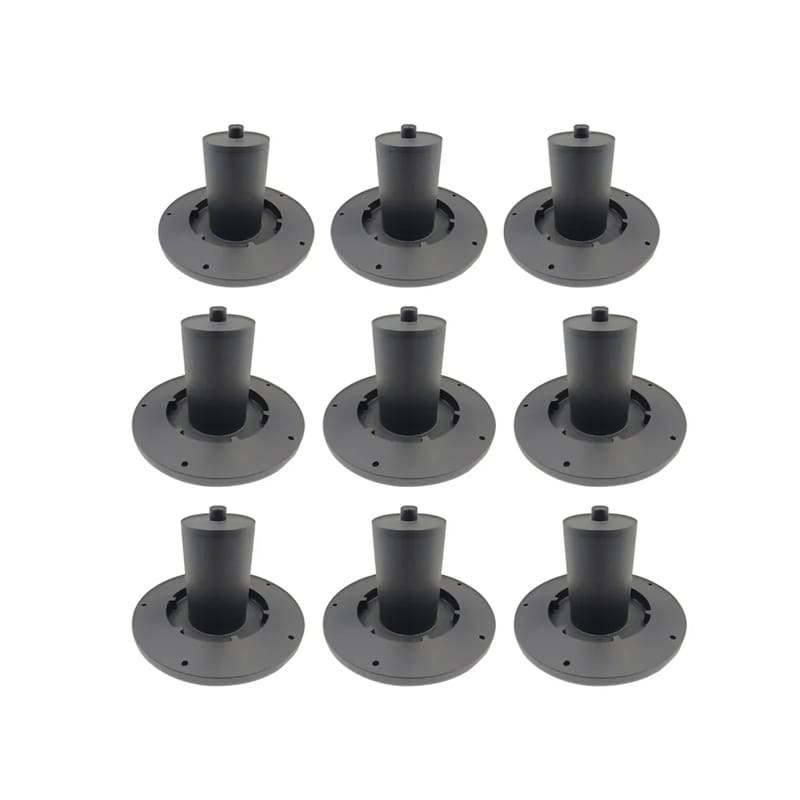
Deep pockets on one side of a plate and thin walls beside thick hubs create asymmetric stress and heat paths. Where possible, balance sections around functional datums and remove stock from opposing faces in stages. These decisions improve POM stability more reliably than adding a very tight flatness note after geometry is frozen.
Use generous inside radii and avoid sharp transitions that concentrate stress. If the component must remain thin, provide inspection support and realistic free-state expectations. A fixture can verify installed geometry but should not hide unacceptable stress that returns after release.
Sequence Roughing, Stabilization, and Finishing
Rough critical features with balanced clamping, leave finishing stock, and allow the part to stabilize before final datums and fits are cut. The appropriate delay and any stress-relief treatment depend on stock, size, grade, and risk. Document the process used during prototype work when POM stability is critical.
Sharp tools, controlled heat, and non-distorting workholding reduce temporary deformation. Measure again after unclamping and after a defined interval. A bore that is correct in the chuck but changes later is a process problem, not an inspection success.
- Use stock with grade and lot identification.
- Rough opposing faces where geometry permits.
- Finish functional datums after major material removal.
- Inspect POM stability after unclamping and stabilization.
- Record temperature and time for critical measurements.
Design Press Fits and Threads for Creep
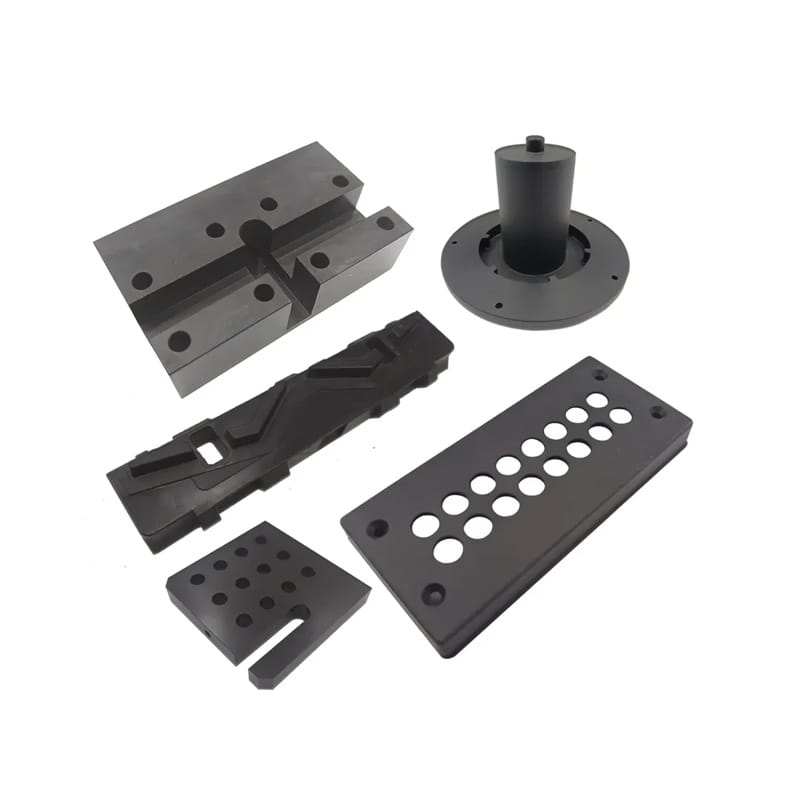
A metal-style interference can generate high hoop stress, close a bore, or relax over time. Review shaft tolerance, hub thickness, temperature, assembly method, and retention alternatives. Splines, shoulders, keys, or metal inserts may provide more predictable retention while protecting POM stability.
Threads need adequate engagement and controlled torque. Repeated service or high clamp load may justify inserts. Avoid placing a thread beside a thin unsupported wall, and provide lead-ins so assembly does not shave or split the polymer.
Allow Thermal Movement in Long Components
Long guides and rails can change length enough to stress fasteners or bow if both ends are fixed. Use a locating point plus slots or floating supports where appropriate. Calculate movement using grade-specific data, but validate the assembly because orientation, load, and constraints influence actual POM stability.
ASTM D648 supports heat-deflection comparison and ASTM D696 addresses linear thermal expansion. These tests are inputs, not a substitute for the installed temperature cycle.
Check Chemicals and Lubricants Under Stress
Cleaning agents, process chemicals, threadlockers, and lubricants can contact a loaded part. Stress concentration around a press fit or sharp corner may make the component more sensitive than an unstressed coupon. Protect POM stability by testing the exact grade under representative temperature and mechanical condition.
ASTM D543 provides a controlled chemical-resistance method. Record dimension, mass, surface change, cracking, and retained function rather than relying on a simple compatible/not-compatible chart.
Validate POM Stability After Assembly
Inspect the free component, assemble it using production torque and fits, then remeasure critical bores, flatness, and center distances. Run the machine through temperature, load, and dwell cycles. Record friction, position, leakage, noise, and any permanent change.
The POM CNC turning parts and POM versus nylon guide pages show precision POM and machining applications. Supply mating-part limits and operating conditions so POM stability can be reviewed as an assembly property rather than a material slogan.
Packaging and storage can influence the condition delivered to assembly. Long slender parts should be supported so they are not stored under a bending load, and hot components should not be sealed or stacked in a way that freezes temporary distortion into the pack. Define orientation, separators, and acclimation when the receiving inspection is sensitive. Packaging does not replace dimensional process control, but it prevents handling from obscuring an otherwise stable machining result.
For replacement components, inspect the mating metal before duplicating a worn polymer sample. Shaft taper, burrs, housing distortion, and changed fastener torque can impose stress that did not exist in the original design. Reconstruct the required interface from controlled hardware and service movement. This prevents a new POM part from being machined to compensate for damage that should be corrected elsewhere. ASTM D790 can support flexural material comparison where stiffness evidence is relevant.
Frequently Asked Questions
Is POM stability better than nylon stability?
POM generally absorbs much less moisture, which can support dimensional consistency. Temperature, stress, machining, grade, and chemistry still need review.
Can machining affect POM stability?
Yes. Heavy asymmetric removal, heat, clamping, dull tools, and residual stock stress can cause delayed distortion. Use balanced roughing and delayed finish inspection where needed.
Does POM stability eliminate thermal expansion?
No. POM still expands more than many metals. Long parts and close clearances need operating-temperature allowance and suitable mounting.
Is a press fit safe for POM?
It can be, but interference, hub wall, creep, temperature, shaft tolerance, and assembly damage must be evaluated. Measure the installed part and consider alternative retention.
How should POM precision parts be inspected?
Define datums, temperature, conditioning, fixture, time after machining, and free or installed state. Recheck critical geometry after stabilization and assembly.
Review POM Stability Before Final Machining
Huadao can review POM CNC turning parts for stock, wall balance, machining sequence, fits, thermal movement, and inspection.
Share controlled drawings and service conditions through the contact page to protect POM stability in the actual mechanism.