A rubber gasket can look simple on a drawing, yet small specification gaps can lead to leakage, uneven compression, difficult assembly, or early replacement. The design has to connect the operating environment, joint geometry, material behavior, manufacturing process, and inspection method.
This practical guide explains how engineers and OEM buyers can develop a rubber gasket specification that is clear enough for quotation, prototyping, production, and quality control. It focuses on the decisions that matter before tooling begins rather than offering a universal material or compression value that may not fit the application.
Table of Contents
What Does a Rubber Gasket Need to Do?
The primary job of a rubber gasket is to maintain a barrier between two mating surfaces while the joint experiences manufacturing variation, assembly load, temperature change, vibration, and aging. That does not mean the softest compound is automatically best. A component that deforms easily may also extrude into a clearance, shift during assembly, or lose sealing force after long compression.
Define the rubber gasket failure mode before choosing dimensions. Is the risk liquid leakage, gas leakage, dust ingress, loss of vacuum, contamination, vibration transfer, or metal-to-metal contact? The answer changes which properties deserve priority. A static enclosure seal, a pump cover, and a protective access panel may all use a rubber gasket, but they should not share a specification by default.
Build the Service Profile Before Selecting Material
A useful rubber gasket design starts with a service profile, not a material name. Record normal conditions, credible peaks, exposure duration, cleaning cycles, shutdown periods, and expected maintenance. A brief temperature spike is different from continuous heat, and occasional splash is different from permanent immersion.
| Design input | Questions to answer | Why it affects the specification |
|---|---|---|
| Fluid or gas | What contacts the seal, at what concentration, and for how long? | Exposure can cause swelling, hardening, softening, or loss of strength. |
| Temperature | What are the normal, minimum, maximum, and cycling conditions? | Temperature changes elasticity, aging rate, and retained sealing force. |
| Pressure or vacuum | Is the load steady, pulsing, or reversed? | Differential pressure can move or extrude the gasket at unsupported gaps. |
| Joint movement | Do the surfaces shift, vibrate, expand, or open during service? | Movement changes local compression and may introduce abrasion. |
| Assembly | How are fasteners tightened and is a compression stop present? | Assembly controls squeeze, load distribution, and repeatability. |
| Regulatory needs | Does the finished part need documented material compliance? | Required evidence must be agreed before compound approval. |
Send this information with the drawing. If a condition is unknown, label it as unknown instead of assuming. That gives the manufacturer a chance to identify a verification step rather than silently designing around an incomplete requirement.
Choose the Elastomer Family from the Actual Exposure
Rubber gasket material selection should balance fluid compatibility, temperature capability, weathering, mechanical behavior, and the required service life. Our rubber material selection guide explains the broader screening process for custom parts. For a rubber gasket, the compound formulation and test requirements matter as much as the polymer family printed on the drawing.
For example, two rubber gasket compounds described with the same generic elastomer name can have different hardness, tensile behavior, compression set, additives, and processing characteristics. The ASTM D2000 classification system provides a structured way to describe vulcanized rubber properties, although application-specific requirements still need agreement between buyer and supplier.
Avoid selecting a rubber gasket from a short material chart alone. Use charts to create a shortlist, then confirm the actual fluid, temperature, pressure, and joint conditions. If regulatory or customer-specific documentation is required, state the exact requirement and the evidence expected in the RFQ.
How Hardness Changes Sealing and Assembly
A rubber gasket hardness specification influences how readily the part conforms to surface variation, how much force is needed to compress it, and how well it resists handling damage or movement into a gap. A harder compound is not automatically more durable, and a softer compound is not automatically a better seal. Geometry and material behavior must be reviewed together.
For rubber gasket quality control, specify the hardness scale and test method, not only a number. ASTM D2240 describes durometer hardness measurements and explains that readings depend on the indenter geometry, applied force, and viscoelastic behavior. It is an empirical control test, so hardness should not be treated as a complete prediction of sealing performance.
When the part is thin, narrow, curved, or difficult to support during measurement, agree on whether hardness will be checked on the finished rubber gasket, on a standard test plaque from the same compound, or by another documented method. Otherwise, acceptable parts can appear inconsistent simply because the measurement setup changed.
Compression and Joint Geometry Must Work Together
Rubber gasket compression needs enough controlled deformation to close the leakage path, but excessive or uneven squeeze can create its own problems. The correct amount depends on compound, cross-section, confinement, pressure, temperature, fastener pattern, surface condition, and whether the joint can bottom out on a solid stop.
In rubber gasket design, do not use one compression percentage for every geometry. A broad flat gasket between rigid covers behaves differently from a narrow molded bead in a groove. The groove must provide space for lateral expansion while still supporting the component against displacement or extrusion. Corners, bolt holes, ribs, and transitions can create local areas of higher strain.
Long-term recovery is also important. ASTM D395 covers compression set testing for rubber under compressive stress, particularly for components such as seals and vibration-control parts. Our detailed article on rubber compression set explains why hardness alone cannot tell you whether sealing force will remain after extended service.
Control Surface, Fasteners, and Load Distribution
Rubber gasket performance also depends on the surrounding joint. Even a well-chosen part cannot compensate for every joint problem. Warped covers, damaged surfaces, wide unsupported spans, and irregular bolt spacing can create low-load regions where a leakage path remains. Excessive tightening near a fastener may crush one area while leaving the space between fasteners under-compressed.
The rubber gasket drawing should identify the sealing land, surface expectations, fastener locations, assembly sequence where critical, and any compression-limiting feature. If the gasket must be removed and reinstalled during maintenance, say whether reuse is expected. Reuse should be validated rather than assumed because the part may take a set, tear at a hole, or become contaminated during disassembly.
Where compressive force is a key design input, ASTM D575 provides test methods for rubber properties in compression. Test data are most useful when specimen geometry and conditions have a defensible relationship to the application.
Set Realistic Dimensions and Tolerances
Rubber gasket dimensions usually include thickness, sealing-bead height, hole position, outer profile, inner opening, and any feature that controls location in the assembly. Mark which dimensions affect sealing and which only affect clearance. Applying the tightest tolerance to every dimension can increase tooling and inspection complexity without improving the joint.
The manufacturing route also matters. A die-cut rubber gasket, a molded flat profile, and a three-dimensional molded component have different design freedoms and sources of variation. Review parting lines, flash, gate or material-flow considerations, draft, and trimming access before freezing the drawing. Our comparison of the rubber molding process can help buyers understand when compression, transfer, or injection molding may be considered.
If the design contains a narrow web, sharp internal corner, deep undercut, or closely spaced holes, ask whether the geometry is robust for production and inspection. A small drawing change can sometimes improve mold filling, part removal, dimensional consistency, and handling without changing the sealing interface.
Validate the Design Before Production Tooling
Rubber gasket validation should answer whether the part seals in the real joint, remains positioned during assembly, tolerates expected exposure, and can be produced consistently. A material certificate or hardness reading cannot replace an application test.
- Confirm drawing revision, mating-part geometry, and installation orientation.
- Review the proposed compound and the properties linked to known failure modes.
- Check fit and assembly using representative mating components.
- Test under credible temperature, pressure, fluid, and cycling conditions.
- Inspect the part after testing for movement, extrusion, cracking, tearing, swelling, or permanent deformation.
- Define production acceptance checks that can be repeated at the agreed sampling level.
Tensile and elongation data can support compound control when they are relevant to the design. ASTM D412 describes tension testing for vulcanized rubber and thermoplastic elastomers. Select tests because they address a risk; avoid adding a long list of properties with no acceptance logic.
What to Include in a Rubber Gasket RFQ
A complete rubber gasket RFQ helps the manufacturer evaluate feasibility and propose a relevant quality plan. For a custom part, include the following information whenever it is available:
- A controlled 2D drawing and, for three-dimensional parts, a matching 3D model.
- The sealing function, medium, pressure or vacuum condition, and temperature range.
- Continuous, intermittent, cycling, cleaning, and storage conditions.
- Mating materials, surface condition, fastener pattern, and assembly method.
- Material or performance requirements, including the requested evidence.
- Critical dimensions, tolerances, appearance limits, and inspection method.
- Prototype quantity, expected production volume, and packaging needs.
- Known field failures or design concerns that the new part must address.
If the drawing is still developing, the customized parts process provides a practical starting point for sharing application details before tooling. Early design review is especially useful when the rubber gasket includes a molded bead, locating tabs, complex holes, or a nonuniform cross-section.
Common Specification Mistakes
Common rubber gasket specification mistakes often come from incomplete or conflicting requirements rather than unusual geometry. Watch for these recurring issues:
- Selecting an elastomer name without defining the actual exposure.
- Specifying hardness without a scale, method, tolerance, or measurement location.
- Using a universal compression target without reviewing the joint and compound.
- Expecting the component to correct excessive flange distortion or poor load distribution.
- Applying tight tolerances to noncritical dimensions while leaving sealing features unclear.
- Approving the material but not testing the assembled rubber gasket under service-like conditions.
- Requesting compliance without naming the applicable requirement or required documentation.
The remedy is straightforward: connect each drawing requirement to a function, failure risk, manufacturing need, or inspection decision. Requirements that have no clear purpose should be reviewed before they become permanent sourcing constraints.
Frequently Asked Questions
What information is most important when requesting a custom rubber gasket?
Start with the sealing function, mating geometry, contacting medium, temperature, pressure or vacuum, assembly method, and expected operating cycle. Add the drawing, critical tolerances, material requirements, test expectations, quantity, and any known failure history.
Is a softer rubber gasket always better for sealing?
No. Softer material may conform more easily, but it can also move, extrude, tear, or become difficult to assemble in some joints. Hardness, cross-section, confinement, surface variation, and applied load need to be evaluated as one system.
Can hardness identify the correct elastomer compound?
No. Hardness is one measured property, not a material identity. Compounds with similar hardness can behave differently in heat, fluids, weather, tension, and long-term compression. The specification should include the properties and exposure conditions relevant to the application.
Should a rubber gasket be tested as a finished part?
Finished-part checks are valuable for dimensions, fit, appearance, and application performance. Some material properties are more reliably measured on standard specimens. The buyer and manufacturer should agree which tests apply to the finished component and which apply to representative compound samples.
When should the manufacturer review the joint design?
Review should happen before production tooling is released. Early feedback can identify unsupported gaps, difficult molding features, unclear tolerances, measurement limitations, or assembly risks while the design is still economical to adjust.
Turn the Application into a Manufacturable Specification
A reliable rubber gasket is the result of aligned decisions: the service profile guides material screening, the joint controls compression and support, the drawing communicates critical geometry, and validation checks the assembled system. None of those decisions should depend on a generic material label alone.
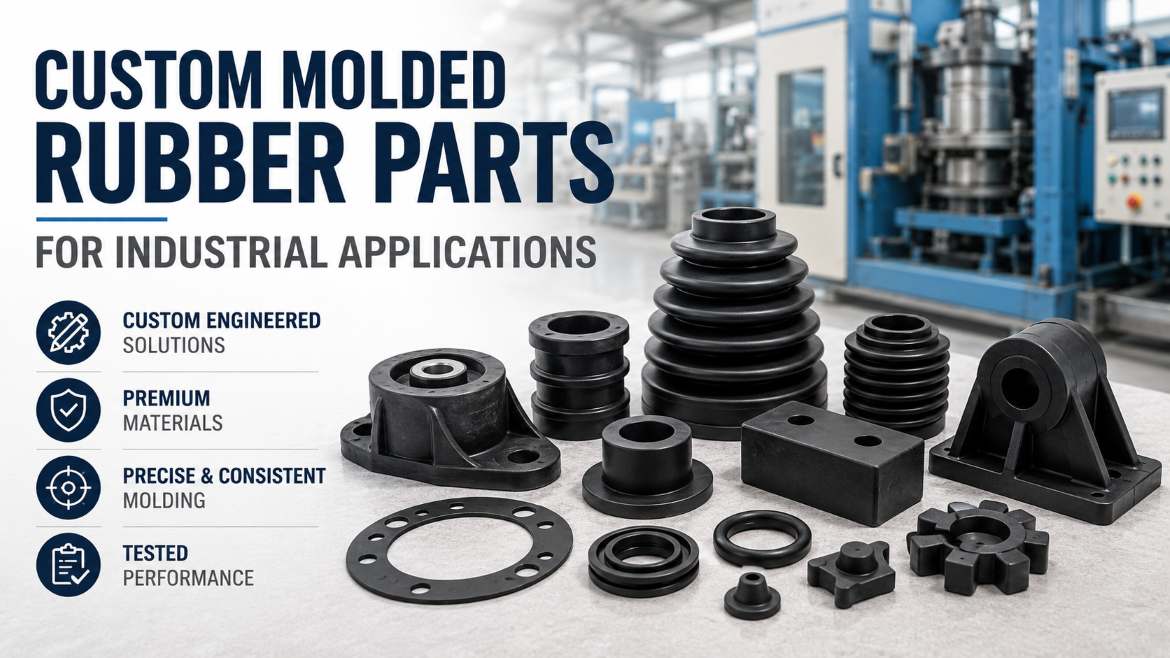
Huadao can review drawings and application details for custom molded rubber parts, including gasket-style components with application-specific shapes. To discuss feasibility, material requirements, prototype needs, and inspection priorities, contact our team with your drawing and service conditions.